Saturday, 11 May 2024

082. Disreputable Magnus


White: The_Thinker95 - friendly game, ChessWorld.net, 2023

I see it's been getting on a year since I last posted here. That's because I've been feeling fed up with chess. That's meant I've not wanted to play league games. I've still had to play but, because I didn't want to, I played quite badly and, because I played badly, I've kept blundering, which has meant I've wanted to play even less. Sigh.

Here's an example. Suspecting preparation (rightly), I deviated from my complicated book line (14...Rf8) in favour of the simpler 14...0-0-0! (the idea of CCIM Nikolaos Ntirlis, and recently endorsed by IM Robert Ris), was rewarded with a winning move (20...Nc3!), which I missed, reached a winning position anyway, only to surrender it (23...Bf3??) for a forced mate that wasn't (25 Rg7!), and then was just a piece down. Sigh.

That was in the Ulvestad Variation by the way, which is where the post title comes in. The 16th World Champion and prime candidate GOAT, GM Magnus Carlsen, has just played a game with 5...b5. (My thanks to GM Ferdinand Hellers for the heads up.) Okay, Magnus had played it at least twice before, but there (after 6 Bf1) he went for 6...h6 and 6...Nd4, which are now both known to be dodgy. On this occasion he was ready with the correct (!) 6...Nxd5 (which I first wrote about in 2019).

The result: GM Dommaraju Gukesh (surprise winner of the 2024 Candidates tournament) spent the entire game defending as White and eventually went wrong (27 Nf3??), only for Magnus uncharacteristically to miss his chance (30...Bd3+ 31 Ke1 Qb6) and have to concede a draw. Sigh.

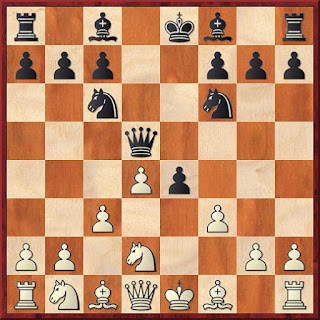
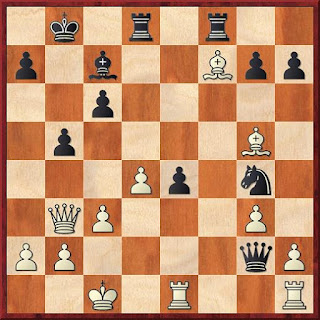
Those games were both in the 8 d4 exd4 9 0-0 Be7 main line by the way. The one below (against a friendly occasional sparring partner on ChessWorld.net) was with 8 d3 Be7 9 Nf3 f6!? (Ris prefers 9...0-0 here). I'd played it all before up to move 18 (where my then opponent overstepped the time limit) and had continued up to 22...Rxe4 in my book,
where I wrote “and Black should be okay, having regained the pawn.” I was duly okay, but it's always nice to play things out.

As for the Ulvestad, I guess it's watch this space. Thanks to Magnus, the variation should now be getting some serious scrutiny. Or perhaps I should say: it's all Magnus' fault.


Tuesday, 27 June 2023

081. Nah


White: aperturaf - all-play-all tournament, ChessWorld.net, 2018

In his June 2023 ChessPublishing column on 1 e4 e5, GM Tony Kosten includes the game D.Naroditsky-M.Timmermans, Titled Tuesday (blitz) 2023, which “demonstrates a dangerous line that hinders Black from castling and culminates in the (...) position after 12 f4. This is tempting for White as Black can quickly find himself in trouble in this line if he doesn't know exactly what he is doing. Here Black played a good novelty, but went astray immediately afterwards and was crushed.”

GM Naroditsky also livestreamed the game, which has since appeared on youtube. At 3:13 he concludes, having won in 19 moves: “Yeah, this Bc4 line basically busts the line. I mean, I've played like this with Black, and it's just so unpleasant to play this. It's like, you can never castle. The engine always finds some ways to stay alive, but like from a practical point of view it's like, it's insanely hard to play. Yeah.”

Nah.

The 7 Bc4 line is certainly challenging (see Game 75), but not the way he played it (7 Bc4 Na5?! 8 Qd3?! Be7 9 Nc3 etc). As I wrote in my book: “if 12 f4 then 12...Qc6!”.
This is rather more than staying alive. White has absolutely nothing here. More than that, I prefer Black with the two bishops. And ...Qc6 is not at all hard to find. IM Timmermans would certainly find it with more time on the clock; i.e. in a situation other than being surprised in an online blitz game, and by a strong GM.

In fact I've won as Black after 12...Qc6. Well, to be strictly accurate, Stockfish says I was winning at move 15 (...Ng4), level at move 20, losing at move 28, winning at move 30 (...Bxc4+), losing at move 31 (Na5), level again at move 32, winning again at move 35, before I finally won at move 37. Such are the vicissitudes of 2350-rated 3-0 blitz on lichess.

The game below deviated at move 12. This is mentioned in my book too, up to 17...Bxg4, when “Black has whatever chances are going”. I see Stockfish 15 gives Black a clear advantage. Well, maybe. From the discussion mentioned in the previous post:

The point is not always what the assessment is as where it's going. Work on and is it trending up or down? Is a clear advantage trending to winning, staying where it is, or perhaps switching between a clear and slight advantage. Stockfish can defend a lot of positions it thinks are +0.8, +1, +1.3 for the opponent. Even more than that sometimes. In the end it comes down to, yes, the opponent is better, but can they actually win?

Or, here, can I actually win. As it happens, I did win. Sweet.

Incidentally, the following month Timmermans got to play the line again. This time he bashed out ...Qc6! (in an equivalent position) and was also winning at move 15. Though Stockfish is not too impressed with that game either. Such are the vicissitudes of IM level blitz on chess.com, I guess.


Friday, 23 June 2023

080. Stockfish vs. Stockfish


Black: I. Rees - C&DCCC Ward-Higgs Trophy, 2023

Towards the end of 2022 I was minded to respond to an article in the New York Times, in which the author wrote: “Out of the 136 games played in the 32nd World Correspondence Chess Championship, 119 were draws.”

Looking at the crosstable you can see that that 119 is superficially correct. However, some qualification seemed warranted, so I tweeted:

Except that Bock withdrew, so all his "losses" can be discounted; similarly Neto-Pessoa where Black "resigned" a level position. So out of 119 real results, only *three* were decisive. Of these, two were one-move blunders (Edwards-Michálek and Schwetlick-Lecroq). Only Osipov-Schwetlick was a win "over the board". Basically Edwards came first because Michálek, who gave him a knight for nothing, only lost one game, whereas Schwetlick lost two. Well done.

Someone then asked: “Do the humans have any input or is it all down to computers?”
To which I replied:

There's a surprising amount of leeway in most positions, so humans can direct how they want play to go, while engines keep it within the bounds of soundness. But as a real contest between humans it's ultimately futile: if a position is at all sound, Stockfish will defend it.

We went into this a bit more in a thread on the ChessPublishing forum, which included a discussion of the strength (or otherwise) of a “centaur” (that is, a human using an engine) compared to that of an engine alone. My opinion was (and is):

That the centaur might be very slightly stronger relies on quite a lot of expertise: that the human knows how to use the engine, does so diligently, and is sensible enough not to overrule it in critical positions.

But note that I said "not significantly stronger" above. I meant that in a mathematical sense; i.e. there's no significant statistical difference; i.e. even in a best case scenario the centaur is hardly any stronger.

To put it in personal terms: I'm a CCSIM (title from 20 years ago), currently rated ca. 2200 over the board, and have been analysing with engines for many years. But if a CC game is, say, me + Stockfish vs. 1200 player + Stockfish – a prime example of centaur vs. engine – I know from the outset that, if the opening is sound and all my opponent's subsequent moves are approved by Stockfish, there's virtually no chance I'm going to win.


Hence, as I also said, and as I've indicated before: “I stopped playing serious CC in 2006. My only games are a couple each year for Nottinghamshire in the C&DCCC.” The game below is from this season's competition.

There is nothing interesting about this game. I hoped my opponent might play 3...f5. He didn't. He played the Berlin. I tried a line that Magnus had won with, and then – once Black had deviated – an odd-looking idea (14 Qc1) from an earlier correspondence game.
It didn't get me anywhere. The game was drawn. The companion game was slightly more entertaining but still a draw. My two games the previous season, against someone rated 1650 OTB (roughly 130 in old money) were also draws.

To reiterate: As a real contest between humans, correspondence chess is ultimately futile: if a position is at all sound, Stockfish will defend it.

Or to put it another way: Stockfish vs. Stockfish is a draw.


Saturday, 31 December 2022

079. The Refutation of the King's Gambit


White: Dougbeer - Thematic tournament, ChessWorld.net, 2022

The title above is from an 11-part 2020/21 series (available for free download) by GM Matthias Wahls, who writes: “In my opinion, the King’s Gambit is clearly refuted by the Schallop Variation.”
Please note that “clearly refuted” doesn't necessarily mean a forced loss. From Wahls’ grandmasterly perspective, an opening is refuted for White if it leads to an inevitable disadvantage. And I am willing to concede that Wahls achieves his objective: White is theoretically worse in the Schallopp, so, on his terms, the King's Gambit can be regarded as refuted.

That's not enough to keep me from playing it. In recent games between the engines, either directly or by proxy, White manages mostly to draw after 3...Nf6. Which is to say, White's disadvantage is not so great that an engine can't defend it. And if an engine can defend against its 3600-rated colleague, I am reasonably hopeful of defending against mine at a lowly 2200 or less. Supposing they're sufficiently well prepared actually to achieve an advantage. Generally, they aren't. In fact, I've never lost to the Schallopp.

From the other side, I am more than reasonably hopeful of winning after 2 f4. To that end, the Wagenbach (2...exf4 4 Nf3 h5) has been very successful for me (over 80% as Black). Yet not as successful as the Schallopp. I've employed 3...Nf6 as an occasional weapon some fifteen times over the years – and won every single game.

This is the most recent example. My eighth move was a novelty. Previously Black has played 8...Ng7, transposing to the main line of Wahls' fourth article. But the engines have drawn against that, so I thought I'd try something else. Had my opponent elected to exchange queens on move 24, the result would probably have been the same. As it was, by the time the queens were due to come off anyway, White had a lost endgame.


Tuesday, 27 September 2022

078. Cheating / Not Cheating


White: tripoduk - Chess.com, 2022

Prompted by the ongoing drama about high-level chess cheating / not cheating, evidenced / not evidenced by various algorithmic methods, notably at chess.com, I've been considering my own results again.

As I mentioned a few posts ago, chess.com have an analysis module that goes through your games afterwards, assessing how accurately you've played. My daily scores, always against players rated 700 points below me, are usually in the 90% bracket, which is high. However, if you get a good position out of the opening, are in control from then on, and are hardly ever threatened, you're not induced into making mistakes and are free to find nice moves. Hence your score will be very high. Or so you'd expect. The module does surprise me sometimes.

For instance, one game I won cleanly in 17 moves – all very satisfactory – and my score came back at 61.2%. Say what?! Okay, I could have played a standard Bxf7+ tactic and didn't. It's the sort of thing I watch for in OTB blitz games as I catch my mate out with it quite often. So I think it unlikely I missed it here. More likely I purposely refrained, hoping for the Legall's Mate trick on the following turn, which I indeed got to play, in effect twice (10 Qxe2). Still... 61.2%?

Well, anyway, the module has recently made amends by awarding me two 100% scores. Naturally, I see fewer problems with those ;). But let's examine them all the same.

The first came from a trap in a Dutch Defence. I only really made one move, an obvious one (12 b3) hitting a defending piece. To that point it was all previous praxis, and the four remaining moves followed straightforwardly.

The second was a trap in a Scotch Game. I'd had this before in an OTB league match, as far as 11...Qf6 – or rather as far as 12 Qf3, since the position arrived in reversed form after 1 Nc3 Nf6 2 e4 e5 3 a3 and so on. In that game I developed the queen's bishop before exchanging the other, which is less accurate than switching it round, though I still won in 24 moves, and with 24 b3 mate no less.

Back in the online game, Black was winning by move 12.
Whereupon the module praises 13 c4 for White and 13...Nxe5 for Black, calling the latter “brilliant” – even though its justification was a simple king and rook fork (14 fxe5 Qxe5+) which was only possible because White had just opened the e5-a1 diagonal. Not exactly brilliant. After that I brought my rooks to the centre files (...0-0-0 and ...Rhe8) and won a couple of moves later.

So what do I conclude from this? Nothing. And I don't expect anyone else to conclude anything either. Chess.com have in fact "concluded" something twice. The first time (2014) I was banned for "cheating". The second (2016) I received an automated “Warning about suspicious play”. On each occasion I replied with a detailed exposition of recent games – with reference to minutely-researched openings, numerous databases (OTB, CC, engine tournaments, and my own engine-enhanced analysis), an extensive library (close to 500 books), and suchlike – and that seemed to satisfy them (whether it's mean of me to utilize all my off-board resources in this fashion is another question). I've not heard anything since 2016, and the earlier ban was rescinded. They even gave me a free Diamond membership. Thanks :)

As for the current furore, I'm Team Hans, at least as regards the Sinquefield Cup. Magnus just played rubbish. Nonetheless, the reason I don't play classical chess online myself is...

The possibility of cheating.


Sunday, 26 June 2022

077. Errata


White: verdi - all-play-all tournament, ChessWorld.net, 2022

No matter how careful you are, errors always slip through. In my book:

Typographical / input errors
So far I've found two incorrect diagrams, an erroneous reference, and a misquote.
– P207 (Two Knights): in the first diagram, the h-pawn should be on h3.
– P251 (Ulvestad): in the first diagram, there should be a pawn on f3. (I must have tweaked the diagrams in the font and then failed to proof them properly.)
– P285 (Jaenisch): line “D2” should be “E2”.
– P307 (Jaenisch): the final word of the first Swiercz quote should be “piece” not “pawn”.
(I guess I had the word “pawn” stuck in my head.)

Transpositional errors
It seems I didn't quite get all the multitudinous transpositions down.
– P95 (Wagenbach): 5 Qe2 d6 6 Nc3 c6 7 d4 g5 is indeed “another main line”, but one Black needs to avoid. Instead, 6...Nc6 is correct, when 7 d4 g5 8 e5 is line E33.
– P129 (Wagenbach): 7...Bg7 does not run “the risk of landing in an inferior 7 e5 line (E33) after 8 e5”, because 8...Nc6! then transposes to my main line E33 again.

Analytical errors
These remain to be seen or shown. However, I have – of necessity – found a small refinement in one variation:
– P240 (Two Knights): At the end of note e) with 20 Bxe6,
I've now discarded 28...Rb8 in favour of 28...g6. There's no urgency to put the rook on b8, especially as the tempo could cost Black in the event of a timely Rc8 by White, swapping the rooks off. Having been forced (by an opponent) to look at this position in more depth, the way to defend is as follows:

Put the queenside pawns on a3 and b4 with the rook in support. The problem then for White, with just one light square between the a-pawn and promotion, is how to remove both pawns. It will require all three pieces: king and rook to capture a protected b-pawn, with the bishop on the a2-g8 diagonal to halt the a-pawn. In response Black can aim to create another passed pawn with ...h5-h4, ...g5-g4 and ...h4-h3 (to overload the bishop), while the king heads for the centre to eliminate the d-pawn. No white pawns on the board means a draw. Another, not insignificant, factor is that, if the white d-pawn is removed and rooks exchanged, even a single black h-pawn can scupper any win, since ...h4-h3 and g2xh3 will leave White with the wrong bishop for the remaining rook's pawn.

This all played out satisfactorily in the game below. Note that the king goes to f8, rather than g7 (on move 31), to avoid ideas of Rc7 and Be6. And later (move 38), that taking on f7 doesn't get White anywhere: 38 Bxf7 g5 39 Bc4 g4 or 38 Rxf7+ Ke5 39 Bc4 Ra8 are both fine for Black.


Friday, 15 April 2022

076. Testing the Theory 2


White: Capalaskine - all-play-all tournament, ChessWorld.net, 2018

This time it's not me doing the testing but (surprisingly) two 3600-rated engines – KomodoDragon and Stockfish – in the ongoing TCEC 22 Superfinal. The theory in question is (again) the 4 d3 Jaenisch, this time with 4...Nf6 5 exf5 Ne7 (see page 287 in my book).

Both engines (a little disappointingly) went for the same line as White: 6 0-0 c6 7 Ba4 (Stockfish actually played 6 Ba4 first) 7...d6 8 Nc3 Bxf5 9 d4 (usually considered to be good) and then 9...e4 10 Nh4 d5 11 f3 Qd7 12 fxe4 dxe4.
Hitherto my own praxis and analysis were my only source here, so I was very interested to see how the engines got on.

Both games (inadvertently) followed one of mine (see below) to move 16. The engines’ joint novelty (17 Nd1) didn't prove a significant improvement as they went on to make two draws. Whereas I (seemingly) turned a draw down at move 33. That's (likely) because I wanted to play it out, rather than thinking I was at all better. In the final position Black is about to regain a missing pawn, hence a draw all the same.

Well, it's nice to see 4...Nf6 holding up, at least for the moment. But, to quote myself: “It’s an exercise in brinkmanship for sure and I don’t always feel up to it. No worries – on such occasions I just play 4...fxe4!.”


Thursday, 17 February 2022

075. Testing the Theory


White: Dlanor - all-play-all tournament, ChessWorld.net, 2021

Well, my book is finally out and you can go and buy it... wherever, supposing you haven't already done so. I'd suggest not wasting any time anyway because, as I write in the Introduction: “Stockfish 17 may refute the whole lot in five minutes”. And we're currently up to Stockfish 14.1.

Meanwhile, I'm still testing the theory in my own games, and to considerable depth. For example, in the main line of E22 in Chapter Ten (Jaenisch 4 d3), which follows analysis by GM Dariusz Swiercz (to 27 Bf4), I've since had the chance to test Stockfish's riposte 27...g5!
as far as 28 Be5 Qxc2 29 Qe3 Qc6 30 Rd1 Rfe8 31 Qd4 Re6 (given by me in a bracket), and supported my comment “that Black can, if necessary, await a convenient moment to take on d6 and reach a drawable endgame”. In the game below we liquidated further to rook + pawn vs. rook and agreed a draw.

GM Keith Arkell (or someone) would want me to prove it over the board, I'm sure. To which end, at the end, something like 46...Rg8 47 Kh3 (or 47 f4 Kc5 48 Rd1 Rg4) 47...Rh8+ 48 Kg3 Rg8+ 49 Kf2 Rh8 50 Ke3 (or 50 f4 Rh3) 50...Re8+ 51 Re4 Ra8, intending ...Kd6, should do the trick.

Which also supports my comment here in an earlier post: “If you want to defend the Jaenisch as Black, study the endgame!


Saturday, 1 January 2022

074. Online Ratings


White: tripoduk - Chess.com, 2021

Online ratings are – how should I put it? – not very reliable. As evidence for that assertion I present my own. On ChessWorld.net I'm rated 2882 right now and have a highest ever rating of 2960. Eat your heart out, Magnus Carlsen. On lichess.org my blitz (3+0) rating is 2403, which also seems a bit high. I'm not an IM-level blitz player.

On chess.com, my blitz (3+0) rating is 2340. That cost me considerable pain and suffering (in the form of appalling and repeated blunders after playing for too long), so it's the only one I care anything about. My daily chess.com rating, on the other hand, is 2244, down from a highest of 2314. The steep decline there is the impetus for this post.

At blitz my opponents are... whoever turns up. You never have to wait more than 10-15 seconds. My opponents at daily are basically just two, whose ratings are currently around 1500. So whenever I win a game – which I nearly always do – my rating goes up perhaps a single point. Anything else causes it to drop considerably.

I've never lost at daily, but there have been a few draws, as in Game 18 and Game 29. Although the chess.com analysis module usually assesses my play in the 90th percentile – because I'm not challenged seriously enough to make many mistakes – that's not always sufficient to win. And the result of the game below actually made me laugh out loud.

Facing the very rare MacLeod's Opening, 1 e4 e5 2 c3!?, I went for a line suggested by GM Bologan: 2...d5 3 exd5 Qxd5 4 d4 Nc6 5 Nf3 e4!? (instead, 5...exd4 is a Göring Gambit Declined, as in Game 5) 6 Nfd2 Nf6, whereupon my opponent surprised me with a troublesome novelty: 7 f3!?.
This logical move removes Black's presence in the centre, leaving White's sturdy d4-pawn dominating. Black should still be okay, but... I don't much like it. I liked it even less after 7...Bf5?! (7...exf3 was necessary) 8 Bc4, when I was in danger of being worse. Escaping that fate via liquidation but then seeing no winning chances, at move 17 I offered a draw, which was accepted and — whomp! My rating dropped 76 points.

Ha ha ha. It would take me another year of winning every game to get back over 2300. Supposing I managed to do that. And supposing I was the tiniest bit bothered.


Monday, 13 December 2021

073. How Could I Play Like That?!?


White: R.C. O'Neale - BCCA Championship, 1994/95

So GM Ian Nepomniachtchi failed in his bid to dethrone World Champion Magnus Carlsen, essentially collapsing after losing the 136-move marathon sixth game. As to why, GM Daniil Dubov offered the following explanation in an interview at chess24.com:

In my view, Ian played five and three quarters of the games brilliantly. The way he operated was fantastic, at the limits of his ability, and he was in no way inferior to Magnus. (...) [T]he main strength of Carlsen is that even on his worst days he doesn’t fall below a certain level, and that level is very high. That isn’t Ian’s strong point. On a good day he can beat anyone, but on a bad one he can lose to anyone. As has already been said, at the end Ian played in such a way that you didn’t need to be Magnus to beat him. That’s precisely what makes World Championship matches so tough. There are a lot of games. At some moment the stress will get to you and the fatigue will tell.

I think Nepomniachtchi may look back at games 8-11 in bemusement, wondering “How could I play like that?!?” At my much lower level I can certainly relate to such feelings, having had correspondence tournaments where I just played atrociously. I look back at my games now in bemusement, wondering “How could I play like that?!?”.

Notable instances are (with my dismal scores in brackets): BCCA Championship 1994/95 (2½/10), Email Olympiad 14 Final (2/11), BCCA-100 GM (3½/14). The first of those is particularly “Huh?!?”, given that I'd won the event the previous two years.

Take the game below. The coffeehouse-style 21...b5 raises the eyebrows for a start. But the follow-up "exchange sacrifice" 22...Ng4 has me completely befuddled.
Even if Black is given a free move after 23 Bxd8 Bxd8, it still looks like total rubbish.

There's more rubbish to be seen in Game 43. However, as I note in that earlier post, I later recovered form to win again in 1997/98. I even won in the same line, this time with the more sensible 19...Qg4 20 Bd2 Qd7. That was a nice game from my perspective, featuring a much stronger ...Ng4 too. But I wouldn't be surprised if my opponent looks back it in bemusement, wondering “How could I play like that?!?”


Monday, 8 November 2021

072. Which Rook and Where?


White: boqsa - all-play-all tournament, ChessWorld.net, 2020

It's a well-known chess quandary. You've castled kingside, your queen's rook is still on its home square, and you have to decide where both rooks should now go. The c-file and d-file? The c-file and e-file? The d-file and e-file? Where?

Here's a case in point.


White is a pawn up but it isn't a very good one, doubled and isolated on the open c-file, and the king resides on that side of the board. Black also has a slight lead in development. The question now is where to put the rooks. The logical destinations are the c- and e-files. The former attacks the c3-pawn with options of ...Rc6-b6. The latter eyes a discovery against White's queen.

Let's try the king's rook:
a) 16...Rfc8 can be met by 17 Rd4 Rc6 (or 17...Qb6+ 18 Rb4) 18 Be2 Rac8 19 Rhd1 and White defends by means of 19...Rxc3 20 Rd8+ or 19...h6 20 c4.
b) 16...Rfe8 might lead to 17 Qf4 Qb6+ 18 Qb4 Qxf2, when Black gets the pawn back, but then something like 19 Qd4 Qf5 20 Bc4 Bxc4 21 Qxc4 Re6 22 Rhf1 Rb6+ 23 Ka1 Qg6 24 Rd7 Rf8 25 Rfxf7 is a draw.

Okay, let's try the queen's rook:
c) 16...Rac8 17 Rd4 Rc6 18 Be2 Rfc8 is the same as line ‘a’.
d) 16...Rae8 is not the most obvious choice, but when we compare this with move 24 in line ‘b’ we see that Black already has a rook on f8 defending the f7-pawn and so has a “free” move. Here 24...h6, creating luft, is useful. (Not 24...Qxc2?? 25 Qxf7+! Rxf7 26 Rd8+ and mates.)

So 16...Rae8 it was. After which I got to play a succession of nice little rook moves:
17 f3 Rc8 (because 18 Rd4 Qb6+ 19 Rb4 now drops the undefended queen)
18 Be2 Rfe8 (because the white bishop is now in danger behind the queen)
19 Qd4 Rc6 (because the queen blocks the d1-rook from defending via Rd4)
20 Ra1 Rd8 (shifting the white queen before doubling on the c-file)
21 Qe3 Rdc8 (now that ...Rxc3 will hit the queen again)
22 Qd4 Rxc3 (okay, the queen moved first)
23 Bd3 Rxd3 and Black won – thematically, in a rook endgame.


Saturday, 21 August 2021

071. Another Line in a Book


White: TomOne - all-play-all tournament, ChessWorld.net, 2021

I've finally finished my book, which will be out whenever it's out. How much other people will be interested in it all remains to be seen.

From my own perspective, for my own chess, I now have a well-worked-out, extremely comprehensive repertoire with the black pieces after 1 e4 e5, though remembering what I've written may prove challenging over the board. Distance chess, no problem; I can just look it up. Since everything in the book has been through Stockfish, this gives me a quite considerable advantage (not least because no one else has it yet).

For instance, I've just had a game with a sort of Vienna Gambit: 1 e4 e5 2 Nc3 Nc6 3 f4 exf4 4 Nf3 g5 and then 5 Bc4. Hmmm, what did I have to say about that?

“a) 5 Bc4 allows Black a favourable Hanstein Gambit, which was favourable anyway; e.g. 5...Bg7 6 d4 d6 7 0-0 h6 8 Nd5 Nce7 and White had nothing, P.Faulkner-J.Tait, Notts Championship 1996. However, Black can also go for more: 5...g4! 6 0-0 (6 d4 transposes to line C21) 6...gxf3 7 Qxf3 (instead, 7 d4 is line C21 again; while 7 Bxf7+ Kxf7 8 Qxf3 Qh4 9 d4 Nxd4 10 Qd3 Ne6 11 Bxf4 Nxf4, M.Vachier Lagrave-H.Nakamura, Chess.com blitz 2020, leaves Black with far too much after 12 Rxf4+ Qxf4 13 Rf1 Qxf1+ 14 Qxf1+ Ke8, even if it’s all sitting at home) 7...Qh4 8 d4 (or if 8 Nd5, J.Nebel-S.Ter Sahakyan, Titled Arena blitz 2021, then 8...Bc5+ 9 Kh1 Ne5 10 Qxf4 Qxf4 11 Rxf4 Kd8 wins) 8...Nxd4 9 Qd3 Ne6 10 Bxe6 (or 10 Nb5 Qe7 11 Bxf4 Nxf4 12 Rxf4 Kd8 13 Rxf7 Qc5+ 14 Rf2 Ne7 and so on) 10...dxe6 11 Bxf4 Qe7 12 Nb5 e5 13 Be3 a6 14 Nc3 Be6 and Black won, O.Westermann-D.Van Donk, corr. 2017.”

Okay, 5...g4! it is then. (Line C21 is the Pierce Gambit, 5 d4, by the way.) The game continued 6 0-0 gxf3 7 Qxf3 Qh4 8 Nd5 Bc5+ 9 Kh1 Ne5.


Here I suddenly thought: What about 10 Qc3 - ? I can't remember whether I looked at that or not. Well, clearly Black should reply 10...Ng4! 11 h3 Nf2+ 12 Kh2 and then maybe 12...Kd8 and I'm threatening ...Nxe4 or ...c7-c6 or just ...Qg3+, seeing as I'm a piece up. And my opponent did play Qc3 but inserted 10 Nxc7+ first, which made it even better for Black, and I won in short measure.

Having mentioned at move ten that I'd researched the whole line with Stockfish a couple of months before, and feeling a bit bad about it, I duly apologized afterwards. My opponent was gracious, taking the loss in good heart. Maybe I shouldn't say that our return game just followed Reprintsev-Yanvarjov, Uzhgorod 1988, until a few forced moves from my side left me winning this one too.

Information is a powerful thing.


Sunday, 20 June 2021

070. A Line in a Book


White: verdi - all-play-all tournament, ChessWorld.net, 2021

I've not blogged for three months. The reason for my absence is that all my time and energy has been going into writing a book. A chess book. A repertoire for Black based on the disreputable openings that appear in this blog. Having very nearly finished it – just half a chapter to go – I'm taking a day off. And using it to write about chess some more right here. Insert rolling eyes emoji.

Well, anyway... one of those openings is 4...Qh4 in the Scotch, so the game below has particular relevance.

White's set-up with Re1 and Bg5 in the main line is one of the most testing. My previous (three) games with this all featured 11...Qf5. One I drew as White, two I won as Black – all well and good – but I wasn't very convinced with any of them. So this time I thought I'd try 11...Bd7, as in the 18th Top Chess Engine Championship Superfinal between LcZero and Stockfish. Although White won their game, I had a novelty in mind for Black.

My idea didn't fare any better. At a critical juncture, where the black king needs to defend himself and his infantry, it turns out he can't.


The desired 20...Kd7?? loses to 21 d5!, intending 21...c5 22 Qb5+ and mates. So I had to give up the extra pawn and then try to hold a major piece endgame with an exposed king and a lot of pawn weaknesses. I didn't manage it.

Due in no small part to precise play from my opponent, concluding in an impressive king march (Kh2-h3-g4-f5-f6-e7-d8-c7xc6-d5-e5) through counterfire from my own heavy artillery. In the final position Kxf5, or Qxh6, or both, would have followed, since 60...Qxh4 61 Qf6+ swaps queens for a trivial win.

Will this reverse put me off 4...Qh4 from now on? No, it won't. I've played it four times since, for (I'm hoping) three wins and a draw. It's simply that, sometimes, you just have to take the hit.


Sunday, 14 March 2021

069. Just Because You Can


White: A. Corish - C&DCCC Sinclair Trophy, 2021

Mainly it's a blitz thing: playing a move simply “because you can”. It applies to those moves made for aesthetic (rather than objective) reasons, purely for the look of them, for the surprise of them, yet which are tactically sound. Some of us take this sensibility into longer form chess as well. The game below features two, even three such instances.

In the opening 4...Nf6!? is an unnecessary extravagance. After 5 0-0 there is nothing better than 5...fxe4, transposing to the main line anyway, whereas White also has the option of 5 exf5!. Nonetheless, I sometimes allow this simply because 5...Ne7! is such a nice reply and (I think) is just about sound. In other words: 4...Nf6!? just because I can.

My opponent, as many others have before, preferred the main line – but then played it uncritically. The moves immediately after 6...d6 are actually crucial. If Black manages safely to castle short, the opening problems are already solved and we can consider fighting for the advantage.

To that end I tried 13...g5!?. Here 13...Ne7 would be the routine continuation and should offer a plus. But I wanted to play 13...g5. And yes, it's tactically justified: 14 Bxg5? Bxg5 15 Nxc7 Qg6 16 Nxa8 Nf4 is a massive attack, while 14 Nxg5 Nf4! 15 Bxf4 exf4 16 Nf3 Qg6 (as in the game) provides excellent compensation, based on ...Rg8, ...Ne5, ...Bxh3 ideas. So 13...g5!? it was. Just because I could.

White should probably leave the pawn alone. My opponent took it and the pressure increased until he felt obliged to sacrifice the exchange. Then 29...Qh4! tied the white queen to defence of f2 with ideas of ...Rg3 and ...Bxh3; e.g. 30 b4 Rg3! 31 fxg3 fxg3+ 32 Kh1 Bxh3 33 gxh3 Rxf3! and wins. White guarded against this with 30 Rh1.


So now what? The obvious move is 30...Bg4, removing the defending bishop, or if 31 Qe2 then the reverse order 31...Bxh3! 32 gxh3 Rg3! wins. But what happens if Black just plays 30...Rg3 anyway?

Let's see: 30...Rg3!? 31 fxg3 fxg3+ 32 Kg1 (shutting the rook in) 32...Qg5 (threatening ...Qe3+) 33 Qd3 Qc1+ (decoying the white bishop from the f-file) 34 Bd1 Qe3+! 35 Qxe3 dxe3 leaves White facing ...Rf2 and ...e3-e2, regaining the piece for a winning endgame. Or if the bishop returns to block with 36 Bf3, then 36...Rxf3! 37 gxf3 Bxh3! 38 Rxh3 e2 sees the e-pawn promote. White might put up a fight with 39 Rxg3 e1Q+ 40 Kg2 Qd2+ 41 Kh3 Qxb2 42 Nd5, but Black would still be winning.

So 30...Rg3!? it was. Just because I could. And it all worked out very nicely :)


Saturday, 30 January 2021

068. N-QR1, Resigns


Black: ianl - all-play-all tournament, ChessWorld.net, 2020

Following on from the previous post, my reversed colours game against the same opponent also had an interesting finish.

This one featured a critical line of the Mason Gambit. After the rarely played 11...g5, I tried an artificial plan of pushing the a-pawn, together with some obscure manoeuvres on the queenside. They didn't come to anything. (I'm not AlphaZero.) Eventually I had to give up a piece for Black's front f-pawn (the result of a reckless sacrifice on move two). And then my a-pawn dropped off as well.

All very nice for Black. The only entertaining part for me came at the close.


Rook, knight and two vs. rook and three. White might only draw by swapping all the pawns off which is never going to happen. So it's merely a matter of choosing how best to lose. That to me often means how nicest to lose:

49 Rd4 Rg3 (creating a mating net) 50 d6 b5+! 51 cxb5 Na8! 0-1 (since mate is inevitable; e.g. 52 d7 Nb6+ 53 Ka5 Ra3 mate, or 52 b6 Nxb6+ 53 Ka5 Ra3+ 54 Kb5 a6+ 55 Kc5 Rc3+ 56 Rc4 Rxc4 mate.

My opponent thought I was being silly, wanting the game to end this way.

But “N-QR1, Resigns”! How many games in chess history have ended like that? :)


Monday, 25 January 2021

067. An Eighteenth Century Fortress


White: ianl - all-play-all tournament, ChessWorld.net, 2020

In Game 32, ‘Grandmasters to the Rescue’, I mentioned a critical variation of the Jaenisch, 9 Nxa7+ Bd7 10 Bxd7+ Nxd7 11 f4!, and how this had been strengthened for Black with 11...Qf5!.

The following year I had a brief discussion about this line with a couple of IMs (pfren and poucin) on the chess.com forum:

jatait47: I'm guessing the engine line meant, deviating from Carlsen-Nisipeanu, is this one: 1 e4 e5 2 Nf3 Nc6 3 Bb5 f5 4 Nc3 dxe4 5 Nxe4 d5 6 Nxe5 dxe4 7 Nxc6 Qg5 8 Qe2 Nf6 9 f4 Qxf4 10 Nxa7+. Yes, the engines all love this move – for a while anyway. I get 10 Nxa7+ all the time in online games and it gives White nothing. (My score over the past two years: P12 W7 D5 L0.) The only drawback is that White can force an immediate draw - and indeed three of my opponents did just that (ffs).

pfren: Quite unfortunately the direct 9.Nxa7+! has practically archived the whole line as problematic for Black.

jatait47: That's certainly more testing than 10 Nxa7+, but it's not so clear either. There's a very important game with 9 Nxa7+ Bd7 10 Bxd7+ Nxd7 11 f4 Qf5! - Nekhaev-Nisipeanu, correspondence 2012. And I'm currently 4½/5 as Black in this line :)

poucin: All this is well covered in Sokolov's "Ruy Lopez revisited" (written in 2009), where he thinks black is ok. However, he concludes Qg5's introduction by: “I would not be surprised if in the future white players focus on the complicated 9.Nxa7 (instead of 9.f4), and that this becomes one of the main lines in the Jaenisch gambit.”

jatait47: Yes, Sokolov was the first to draw attention to 11...Qf5!, but other players have taken this line further since then. In particular, Nisipeanu came up with 12 Nb5 0-0-0 13 a4 Bb4!, which improves on Sokolov's 13...Bc5.

pfren: That game featured a clever recipe by Livi (13.a4 Bb4!?), but this is not enough. Instead of Nekhaev's 14.c3?! and the great piece sac 14...Nc5! white could (and should) trade Queens with 14.Qc4! Qc5 (forced) 15.Qxc5 Nxc5 16.Ke2, or 16.Nc3, when it is very hard to show compensation for a two-pawn deficit.

jatait47: Yes, that's the engine's first choice. But 13...Bb4! wasn't some casual punt in a blitz game. This was high-level correspondence, where both players obviously considered 14 Qc4 for White. In fact Nisipeanu had prepared the whole thing to play against Carlsen. After 14...Qc5 15 Qxc5 Bxc5 and then, for instance, 16 Ke2 c6 17 Nc3 Ne6 18 Nxe4 Rhe8, Black actually has compensation for three pawns, as Junior Tay shows in his recent book. Apparently, Nisipeanu was more worried about 14 0-0 Qc5+ 15 Rf2 Qxc2 16 d4, though that's defensible as well (my one draw came in this line).

The last word was mine and I've had no cause to revise my opinion. In five more games with 11...Qf5 since then I've scored W1 D4 L0, including three draws after 14 Qc4. The game below is one of them.

But I'm not showing this game because of the opening, rather because of the ending. My opponent's valiant efforts to try and win culminated in 46 Ra7, allowing – indeed forcing – the exchange sacrifice 46...Rc3+! 47 Nxc3 Bxc3, and reaching this position.


This is a fortress, dating back to E.Del Rio in 1750. Note that Black's pawns are irrelevant. (I played simply to give them away.) The crucial point is that Black's king is safe, since White's king cannot approach. The white pawn blocks off the c6-square and the bishop can drive the king from either b6 or d6. If the pawn advances, it will get taken off for a draw with bishop vs. rook.

Moral: If you want to defend the Jaenisch as Black, study the endgame!


Sunday, 29 November 2020

066. Can I Still Draw?


White: afms - all-play-all tournament, ChessWorld.net, 2018

Perhaps the most important question to ask about provocative openings is whether, should your opponent find (or know) good moves, you'll still be able to draw. An affirmative answer means you can essay that opening with confidence, ready to conduct a difficult defence if required or, more frequently, have your fun when it isn't. An answer to the contrary means you're essentially playing Hope Chess. In that case you'll need both to fake confidence and be prepared even so to take the occasional hit.

Colours are naturally a factor. As White you have considerable leeway to play suboptimally while remaining within the drawing zone, supposing you regard a draw as a satisfactory result. As Black a draw is theoretically theoretically acceptable, but the margins are tighter. A couple of inferior moves, especially in an open position, can mean you're losing right off the bat. I don't like to lose.

And yet I do like quarrelsome openings, particularly as Black. Here's a case in point: the Two Knights Defence with 4 d3. White refuses the confrontation posed by 3...Nf6 and simply defends the e-pawn, aiming for a slower, more positional game. Okay, we can go along with that, aiming to equalize after 4...Bc5, 4...Be7, or even 4...h6, all of which I've played on numerous occasions.

On the other hand, if you eventually end up wondering why you're bothering, you might be tempted just to push 4...d5. It's the sort of move you want to make with one finger. That's what I think of your opening. Pah.

Of course, breaking in the centre is very thematic. The downside to doing so so soon is that the e5-pawn is left exposed. And if White is unphased by your aggression and goes and takes it off, what then? Then we must show we can still draw.


From the diagram: 9...Bxf2+! 10 Kxf2 Qh4+ 11 Kf1 (11 Kg1?? Qd4+ is a not completely obvious trap) 11...Qf6+ 12 Qf3 Qxe5 13 Bxd5 c6, followed by 14...Qxh2, leads to an obscure non-Italian middlegame with rook and pawn vs. bishop and knight. Yes, the minor pieces ought to favour White at this stage – certainly Stockfish thinks so. Nonetheless, my score is P5 W1 D4 L0. Lost nil. It's not always easy, but it seems Black can still draw. The game below is a typical example.

At the finish, 33...Kh7 34 Bf6 Rexf6 35 Nxf6+ Rxf6 36 Rxh4+ Kg7 37 Rh3 Rg6 38 Kf1 c5 39 Ke2 f5 40 Kf3 Rb6 was one way to reach a drawn ending.


Tuesday, 29 September 2020

065. Lockdown


Black: A. Eccles - BCCA Premier, 1996

The game below features the Scotch, Mieses Variation, with the then topical 9...Qh4!?. Black's nice idea is 10 a3 Bc5 11 g3 Bxf2+, followed by 12 Kxf2 Qd4+, winning the rook on a1, or 12 Qxf2 Qe4+, winning the rook on h1. The geometry of the twin corner captures is very pleasing.

Unfortunately, it's all rather specious. After 12 Qxf2 Qe4+ 13 Kd1 Qxh1 14 Nd2! White gains huge compensation for the exchange, in terms of time, control and the initiative, while Black must hurry to extricate the queen. Hence 14...Nc3+ 15 Kc2 Ne4 16 Nxe4 Qxe4+ 17 Bd3.


Now the best Black has is 17...Qg4 18 Bf5 Qh5 19 h4 f6 20 exf6 gxf6 21 Bb2 0-0-0 22 Bxf6 0-0-0, which involves returning all the material for a much inferior position, with the bishop self-isolating on a6 and White's kingside pawn majority ready for a trip to the seaside.

The course of the game was even worse. In the final position, my opponent – still material up (rook and three pawns for two bishops) – resigned because his king and king's rook were in an enforced and permanent lockdown.

I tried to think of something to say about face masks and support bubbles as well, but I guess I've pushed the metaphor far enough.


Sunday, 31 May 2020

064. The Box of Pawns


Black: bobby fissure - thematic tournament, ChessWorld.net, 2007

In a just-finished game I had the small pleasure of creating the “box of pawns”. Two sets of doubled pawns on adjacent files – created by two pawns, three files apart, capturing towards each other – can sometimes be arranged in a little square or “box”. In my game this occurred on e4, e5, f4 and f5. Unfortunately, it was in a Sicilian and hence not blog relevant.

Not wishing to be deterred, I've searched through my game databases looking for other instances and found three more. Two were “over the board” and hence not applicable either, but there was one in an online game. It was only an incidental box, lasting for a single ply, as a pawn recapture removed it at once. Nevertheless, a box is a box, so here it is in all its temporary glory:


The game itself isn't too interesting. I was already winning when my opponent left the queen en prise. And it featured the KGA Modern Defence with 3...d5. I tend to roll my eyes, often literally, whenever this line is proposed as an “antidote” to the King's Gambit. Sure, it's perfectly fine for Black, who can look forward to theoretical equality. But Black can count on at least that with virtually any defence to the King's Gambit.

So, in effect, the Modern means returning a dubiously donated pawn for an equality Black already has anyway. I'm rolling my eyes now just at the thought of it.


Monday, 18 May 2020

063. Four Exchange Sacrifices


Black: Decus Tutamen - all-play-all tournament, ChessWorld.net, 2020

Theory advances inexorably. In the Traxler, for instance, 5 d4, which used to be considered totally harmless, now appears to be the critical move. IM Panayotis Frendzas has proselytized for it on the forums, and that led me to try out 5 d4 myself as White in online thematic tournaments. My score: P14 W12 D2 L0. As someone who generally plays this as Black, those results are not encouraging.

As it happens, I've faced 5 d4 twice too during the same period – and managed to defend the position after 5...d5 6 Bxd5 Nxd5 7 dxc5 Ndb4 8 a3 Qxd1+ 9 Kxd1 Na6 10 b4 Nd4, but it's not the most fun I've ever had – and White can probably improve anyway.

Instead, the game below followed some analysis by Stefan Bücker (whether my opponent knew it or not), where White sacrifices the exchange for two pawns and far greater activity (given that Black's remaining pieces are all on the back rank).

More exactly, we followed it up to a point because, rather than accept the exchange straight away, my opponent first sacrificed the exchange himself (with 13...Rxf3!?). This led to equal material – but not equality.


Black's king is still stuck in the middle and he has a weak e-pawn. The one point in his favour is that the white a-pawn is also weak, which means endings are not hopeless for Black. So, rather than liquidate, I played for an attack on the kingside. This my opponent neutralized by sacrificing another exchange (27...Rxg5), leading to another endgame where my extra material was not enough to win, even after the queens came off.

Well, perhaps I could have played more strongly somewhere. Stockfish is keen on 24 a3!? for some reason. But a game is a game. The only move I actually regret not playing is 38 Qxd3+, because a plausible line then runs 38...Kc8 39 g3 Qh6 40 Qe3 Qh2+ 41 Kd1 Bf5 42 Qe8+ Kb7 43 Rxb5+! axb5 44 Qxb5+ Ka7 45 Qxf5 Qxg3 and White reaches a pawn-up queen ending.

It doesn't win either, please note. But at least that way I wouldn't have been outdone on exchange sacrifices.